
Choir as threshold
The liminality experienced within a community choir evening

Sherry Turkle wrote in her book Alone Together: Why We Expect More from Technology and Less from Each Other
“Anthropologist Victor Turner writes that we are most free to explore identity in places outside of our normal routines, places that are in some way “betwixt and between.” Turner calls them liminal, from the Latin word for “threshold.”
As a community choir leader I am acutely interested in looking at how we can build relationships with each other through the commonality of singing together. We learn songs by ear, without printed words and build our learning slowly, at a very human pace. No one is left out, no voice is more important than another and I hope that we are learning, in our small ways, to expect more from each other in those sessions in terms of support and friendship. We are learning communitas.
Plus the choirs are sounding might fine…
This is From Scratch Choir Newquay singing Hold On by Heidi Wilson - a song of resistance being learnt across singing communities this month.
A friend reminded me too the other day of the original quote by Victor Turner that I wrote about in my MA dissertation last year –
“Liminal entities are neither here nor there; they are betwixt and between the positions assigned and arrayed by law, custom, convention, and ceremonial.”
We felt that sense of liminality last night in Newquay. Two members had told me a few weeks ago that they had been supporting an old friend in his dying days, going up to see him every few weeks in the north of Cornwall. He had talked with them about his funeral, and I had caught glimpses of tales of natural wicker coffins, burial sites and his community gathering around him to put his wishes into place.
As I said hello to M last night, I could see that he was holding onto something poignant just by his body language. He told me that J had died last weekend, and I witnessed his shoulders slump a little as he said those words out loud, and the corners of his eyes take on a familiar wistfulness. The first thing I needed to do was give him a hug – that wordless embrace to let him know that he was seen and understood in his grief.
We went on to talk a little of J’s last hour. He had died in the liminal moment of dusk, as the sun was setting and the full moon rising. Outside his room, a robin sang in the gathering dark. Sunday was also Imbolc in the Celtic calendar – a moment of in-between time that has been written about on Substack a fair bit this last week. It is a time of stillness where winter is quietly shifting into spring but isn’t quite ready to burst forth with the full song and dance of hosts of daffodils and no-coat blue sky days.
As a community choir in Newquay, we have been singing together for well over two years and have witnessed many liminal moments of different sorts. I make sure to mark the end of our sessions with a quiet unspoken ritual of threshold shift every week, as we sing a candlelit song, often a Hebridean favourite.
The choir have grown to trust my slightly hippy ways and are not surprised by little stories of standing stones or full moon selkie tales. This trust allows us to embrace the threshold spaces and fully name our grief in moments like last night.
We sang Standing Stone for J. It is a three-part short circular song, written by Melanie DeMore for a friend who had end stage ovarian cancer. We have used it on many occasions as a reflection of the notion that we will all need a standing stone at some point in our lives – a friend to be there as we traverse difficult moments. But we will also, inevitably, be that standing stone for others too.
Here is Melanie leading her song from a 2014 video…
The three harmony parts have often reminded me of the quoits around West Penwith where I live. Our three lower, middle and top harmony lines are akin to the standing stones as seen at Carwynnen Quoit with our final blended harmony feeling like the capstone.
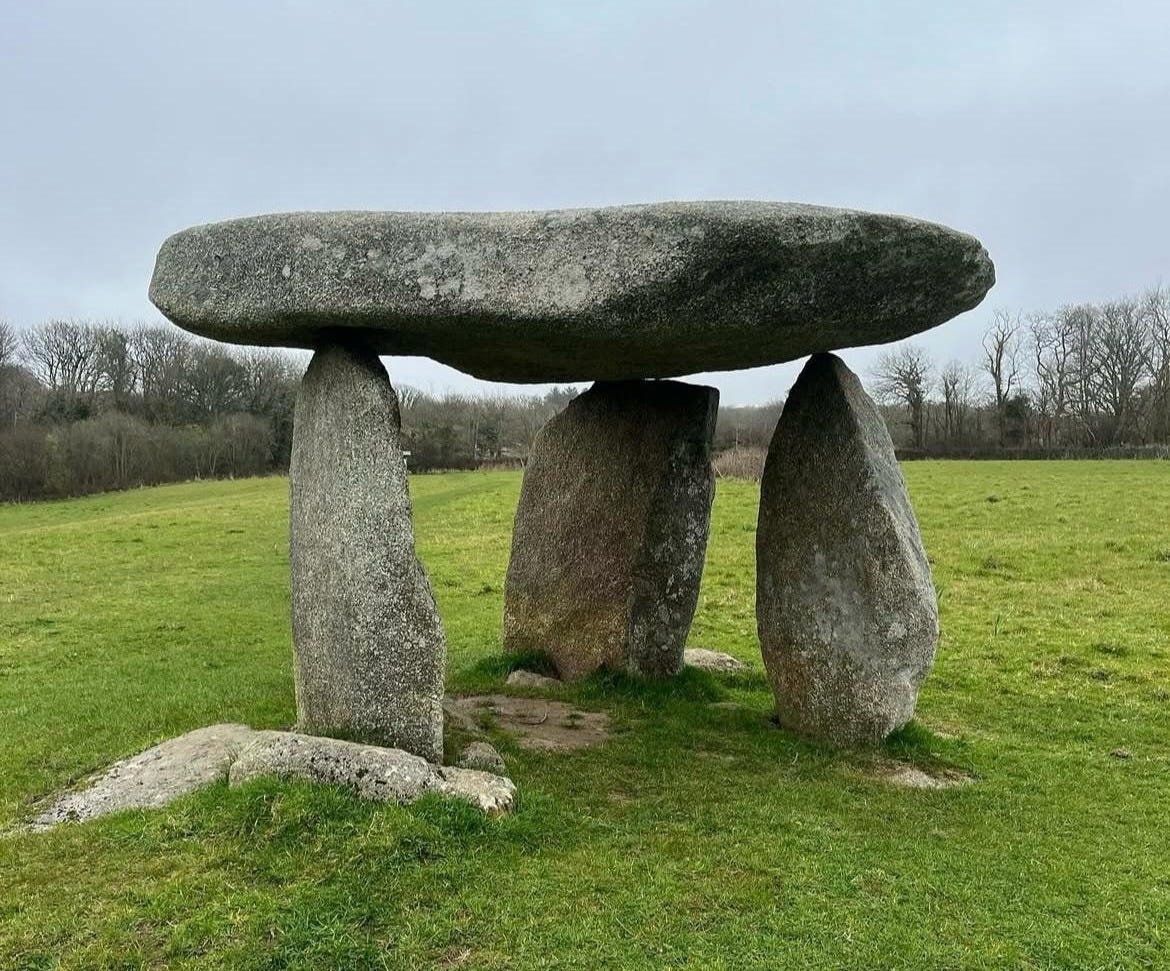
(photo thanks to Stone Club)
So last night, we sang together, around a single candle lantern, the hall lights switched off – twenty five people gathered in a circle. There is a magic in that circle that is undefinable. The very act of breathing in sync with other humans has long been documented as healing to our parasympathetic nervous system, but the magic goes beyond that. For me, it is the sense of joining in community in an otherwise fairly mundane church hall, that becomes completely transformed by voices singing together into a space out of time and reality.
Maybe that is liminality in action. I think it probably is. It comes back to what Victor Turner put so succinctly when he talked of communitas being the
“intense, egalitarian ‘we‑ness’ that arises when normal hierarchies fall away and people experience one another as equals.”
It also harks back to the notion of community grief rituals that Frances Weller writes about in his book The Wild Edge of Sorrow in which he talks about how,
“We step into ritual ground in the hope of being changed.”
Stepping into a choir session might not be an obvious ritual ground, but by allowing that choir community to fully experience the different states of liminality, guiding them gently along the way – they are able to participate in co-created rituals through the simple act of singing together. Community magic.
I would love to hear your thoughts or comments about how communitas shows up for you in your everyday lives - maybe it’s at choir, or in your rowing crew, or while you’re out surfing or maybe it’s in the coffee shop where you order that flat oat white every morning?
💚 Thank you for sharing this Alex!